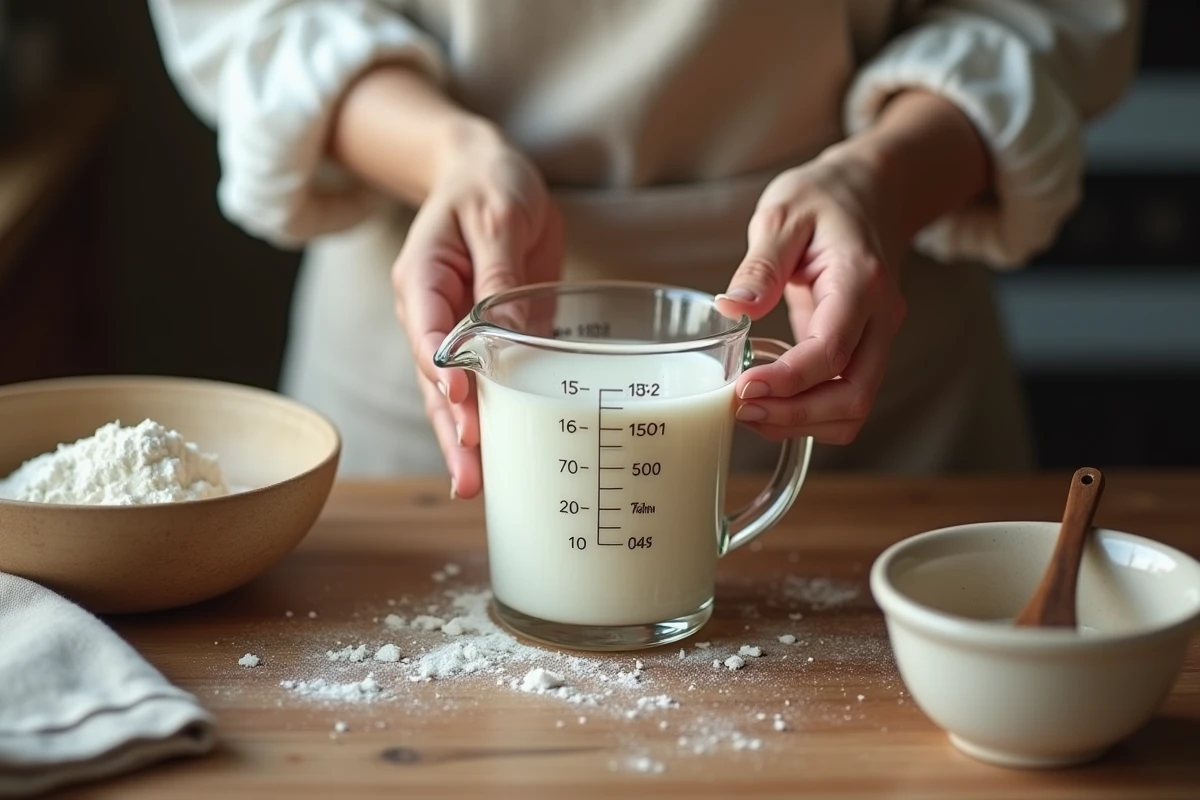
You open the refrigerator, and there’s a little bit of milk left in the bottle. Not enough for a bowl of cereal, but too much to throw away. These few centiliters of milk, often overlooked, are actually an underestimated culinary lever.
A small volume of milk adds flexibility to a dough, creaminess to a sauce, and moistness to a cake. Knowing what to do with it prevents waste and opens the door to quick preparations, often better than those made with a whole liter.
The precise role of milk in a recipe according to the quantity
Before looking for a recipe, it’s important to understand what milk does in a preparation. Milk serves three distinct functions in cooking: it hydrates, it binds, and it adds fat.
When you add a small volume of milk to a pancake or crepe batter, you hydrate the flour without drowning it. The result is a smooth batter that spreads easily and cooks evenly. With a larger volume, the batter becomes too liquid, and the crepes tear.
In a béchamel or a sauce, milk acts as a binder between the butter and the flour. Adding it gradually, in small amounts, avoids lumps. Pouring all the milk at once has the opposite effect. That’s why sauce recipes often call for a modest volume.
Knowing precisely what 10 cl of milk corresponds to allows you to measure without a scale or measuring cup, directly with a simple visual cue.
The fat in milk, even in small quantities, also plays a role in the final texture. A flan made with whole milk will be creamier than one made with skim milk, even with the same volume. The choice of milk type is as important as the quantity used.

Savory recipes with a small volume of milk
A little bit of milk finds its place in everyday savory preparations. There’s no need to plan an elaborate dish: a few centiliters are enough to enhance simple meals.
Homemade creamy mashed potatoes
Mashed potatoes absorb milk like a sponge. Add warm milk (not cold, or the mash cools down and becomes sticky) after mashing the potatoes with butter. A small volume of warm milk gives a smooth mash without making it liquid.
Quick béchamel for gratins
The classic béchamel is made with very little milk. Melt a knob of butter, add a tablespoon of flour, then gradually pour in the milk while stirring. You’ll get a thick sauce in just a few minutes, perfect for coating endives with ham, a pasta bake, or vegetables.
Quiche filling without cream
Don’t have fresh cream on hand? Milk can replace it in the quiche filling. Mix eggs with milk, season, and pour over your filling. The texture will be lighter than with cream, but still perfectly successful.
- Root vegetable mash (carrots, parsnips, celery): milk softens bitterness and smooths the texture after blending
- Velvety soup: add milk at the end of cooking to transform a rustic broth into a velouté without adding cream
- Mornay sauce: a béchamel enriched with grated cheese, ideal for homemade croque-monsieur
Sweet recipes to use up leftover milk
Sweets offer even more possibilities with a small volume of milk. Basic pastries rarely require more than a glass.
Pancake batter for two
A reduced pancake batter recipe uses exactly this type of volume. One egg, some flour, a bit of milk, a pinch of salt. You’ll get four to five thin pancakes. No leftovers, no waste.
Quick flan without crust
Homemade flan only requires milk, eggs, and sugar. Heat the milk with a split vanilla pod (or a few drops of extract), mix with beaten eggs and sugar, then bake in a water bath. The result is a creamy dessert ready in under an hour.
Milk jam
Less known than salted butter caramel, milk jam is made by cooking milk with sugar over low heat for a long time. With a small volume, you get a jar of homemade spread, perfect for spreading on pancakes or toast. Slow cooking transforms lactose into natural caramel, giving it that characteristic amber color.
Replacing cow’s milk with a plant-based alternative
Are you lactose intolerant or looking to reduce your dairy consumption? Plant-based alternatives work in most of the recipes mentioned, but not in the same way.
Oat milk is the most versatile. Its slightly thick texture makes it suitable for béchamels and purees. Almond milk, lighter, is better for sweet preparations like flans or pancakes. Coconut milk adds a strong flavor that directs the recipe towards exotic tastes.
- For a béchamel: prefer oat or soy milk, which thicken well during cooking
- For a flan or dessert: almond or hazelnut milk adds a subtle note without masking other flavors
- For a puree: unsweetened soy milk behaves like cow’s milk, without altering the taste of vegetables
The result varies depending on the chosen plant milk; it’s not enough to replace volume for volume without considering the desired texture. A sweet plant milk in a quiche, for example, will yield an unpleasant result.
Storing leftover milk in the refrigerator
A little bit of opened milk can be stored in the refrigerator for two to three days, provided it is covered. Don’t leave it in the door of the refrigerator, where the temperature fluctuates with each opening. Instead, place it on a central shelf.
If you don’t plan to use it quickly, pour it into an ice cube tray and freeze it. Each milk ice cube represents a portion ready to be added to a soup or sauce. This simple method prevents waste and allows you to keep milk for several weeks without losing quality.
A small amount of leftover milk is not waste. Mash, béchamel, flan, pancakes, or milk jam: the recipes that take advantage of it are among the simplest and most satisfying in everyday culinary repertoire. The next time you hesitate in front of that little bit left in the bottle, choose one of these preparations instead of the sink.