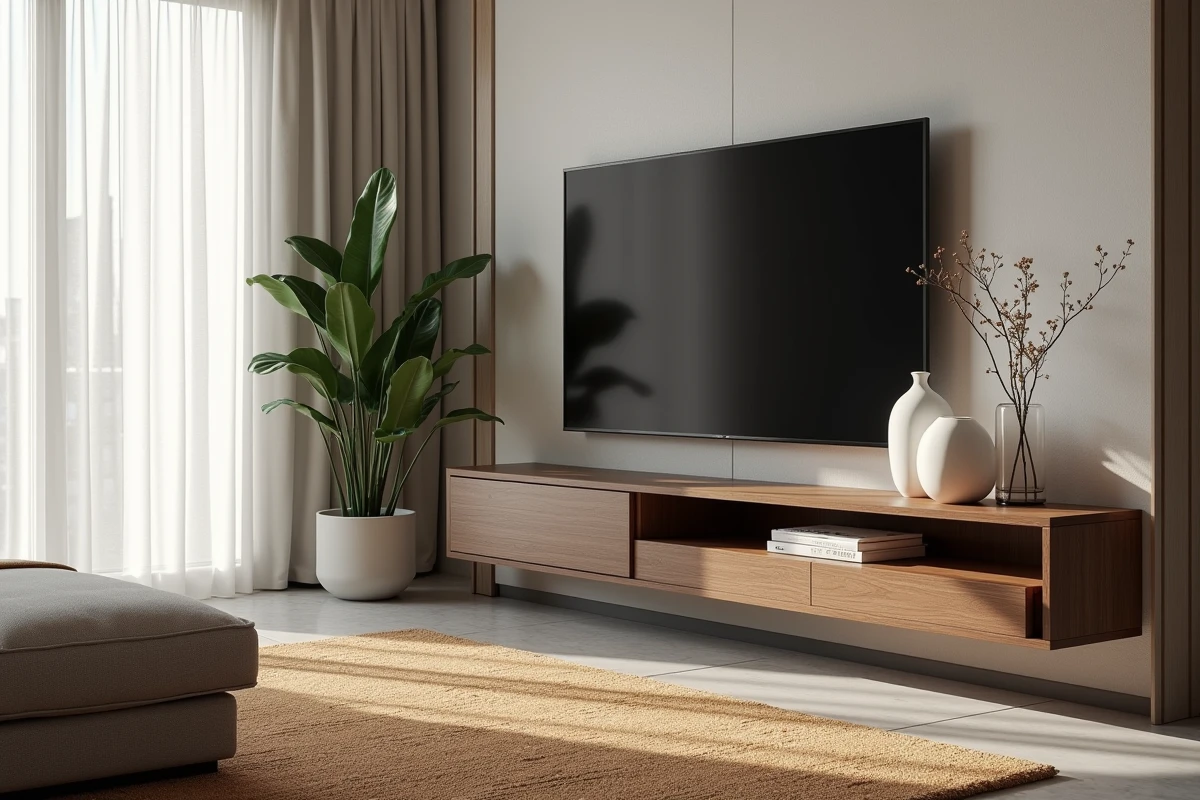
A modern corner TV unit is not just an aesthetic compromise to fill a nook. It is a spatial correction lever that restructures the flow in a poorly proportioned living room, transforms a dead zone into a focal point, and frees up the main wall for other uses.
Correcting the proportions of a living room with a corner TV unit
A L-shaped living room, a long sitting area, or a through room poses the same problem: the wall opposite the sofa is rarely the most suitable for the screen. Placing a linear TV unit against a narrow wall visually crushes the room. The corner, on the other hand, utilizes an unused surface without encroaching on the passage area.
We observe that the corner corrects a proportion imbalance better than a linear unit. By orienting the screen diagonally, the gaze travels along the longest dimension of the living room, which amplifies the sense of space. The focal point shifts to an oblique axis that breaks the corridor perception.
To go further, you can explore layout ideas on D Kom Déco that illustrate this principle with concrete configurations.
The depth of the corner unit plays a direct technical role. A model that is too shallow causes the screen to overhang and negates the integration effect. We recommend a minimum depth on the diagonal that allows the TV stand to fit without overhang while maintaining ventilation space at the back for connected devices.
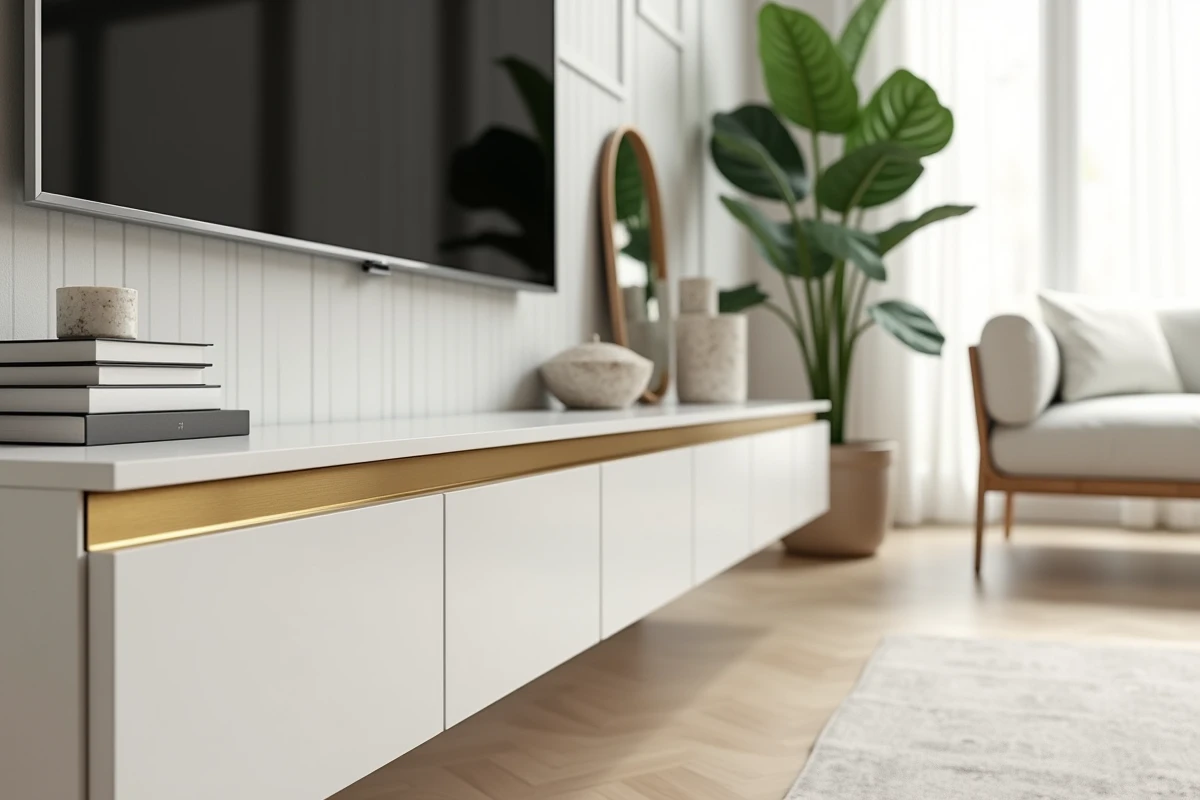
Corner wall composition: going beyond the isolated unit
The most marked trend for 2026 is to treat the TV corner not as a standalone piece of furniture, but as a complete wall composition integrated into the corner. Asymmetrical shelves, open niches, recessed lighting, and closed storage form an architectural ensemble that dresses both adjacent walls.
This approach borrows from the codes of interior architecture. The television is no longer placed on a unit; it is embedded in a device that visually recesses it while keeping it accessible. The result: a structured living corner that no longer depends on a single furniture element.
Materials and combinations that work in corners
Wood remains the dominant material for TV units in 2026, but it is its treatment that evolves. Slatted finishes (lattice effect or vertical slats) particularly suit a corner because they create a play of shadows that softens the edge of the wall.
- Light oak combined with matte lacquered fronts produces a soft contrast, suitable for bright living rooms where the corner receives little direct natural light.
- Bi-material panels (wood and black metal or brushed brass) add relief without overloading, playing on texture rather than color.
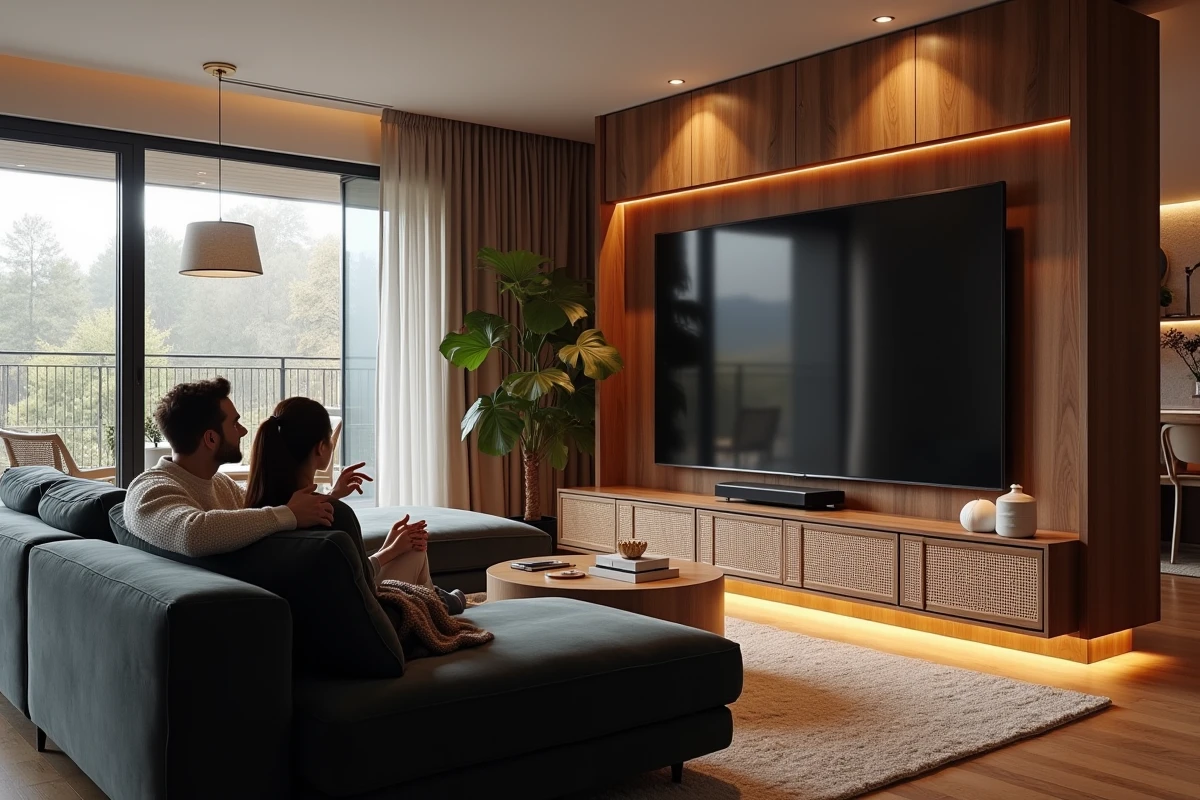
- Dark finishes (dark walnut, anthracite shades) combined with integrated LED strip lighting transform the corner into an alcove, enhancing the depth effect.
Integrated lighting is not decorative; it is functional: it reduces eye strain caused by the contrast between the lit screen and a dark wall while highlighting the objects placed in the side niches.
Modular corner TV unit: configurations for small living rooms
Urban living rooms with limited space do not tolerate dimensional approximation. A modular corner unit allows for adjusting the footprint according to the actual corner configuration, without requiring expensive custom solutions.
Current modular systems work with stackable or juxtaposed elements: a central corner box complemented by lateral extensions of varying lengths. This modular logic frees up the main wall for a sofa or a bookcase, radically changing the flow in a small living area.
Technical criteria to check before purchase
- The load capacity of the top surface: a large screen is heavy, and low-quality particle board structures flex beyond a certain weight. Prefer high-density MDF or solid wood for the load-bearing surface.
- The integrated cable passage: a corner concentrates connections (box, console, soundbar). A unit without a back duct or cable management forces you to drill or leave wires exposed, ruining the desired visual effect.
- The height of the screen center relative to the sofa seat: the optimal viewing axis places the upper third of the screen at eye level when seated. A corner unit that is too high or too low causes neck strain during long sessions.
Minimalist style or bold corner TV unit: what choice for 2026
Two directions coexist. The first, minimalist, seeks to make the unit disappear: floating shelves fixed in the corner, a wall panel that conceals the turned-off screen, absence of visible legs. The TV becomes an architectural element, not a piece of equipment placed.
The second direction embraces the unit as a full-fledged piece of furniture. Solid wood legs, crafted fronts, visible handles: the corner TV unit asserts its presence and contributes to the living room’s style just like a sideboard or console.
We recommend choosing based on the density of furniture in the living room. A sitting area already filled with furniture benefits from an integrated treatment that lightens the visual reading of the space. An uncluttered living room with few pieces can support a bold corner unit that anchors the room.
The choice of style also dictates the finish of the adjacent wall. A minimalist floating unit calls for a wall painted in a contrasting shade or dressed with slats. A legged corner unit works better against a neutral wall that allows it to express itself without visual competition.
The corner TV unit is no longer a second choice reserved for difficult spaces. In 2026, it is a spatial design tool that responds to real constraints of proportion, circulation, and technical integration, provided it is dimensioned rigorously and placed within a coherent wall composition.